

“Fairytales and Hollywood movies have led us to interpret the warning sings of domestic abuse - obsession, jealousy, possessiveness - as sings of passion, not danger.” (Jess Hill)
A more sensitive portrayal of intimate partner violence
Why is this important?
The most dangerous place for women in Central Europe is their own relationship. Worldwide, one in three women experiences physical or sexual violence, most of it within partnerships. Men are also affected; in Germany, for example, one in five victims of domestic violence is male.
Violent relationships are therefore a large part of our social reality, and it is precisely this that is often depicted in films. Films have thus also contributed to declaring transgressions and the beginnings of violence to be gray areas, or to trivializing or even romanticizing them.
Cinematic reality does not remain solely within the fictional space films. Rather, it influences other realities. People draw on ideas when they act. And these ideas do not necessarily have to have happened in real life. They can also result from fictional representations.
Introduction
The basics
This is not (only) about beatings, rape, and murder. In some of the most violent relationships, physical violence is rare or even non-existent. Intimate partner violence primarily means psychological violence.
Prolonged psychological abuse gradually wears down the victims emotionally. Their will is broken, and they come to accept their own devaluation as truth. The slow escalation of violence makes it difficult for partners to identify it as such — and even outsiders often fail to recognize it. Family systems and social relationships are not independent of the social system and are therefore also subject to the structural violence inherent in it. Financial dependence or social trivialization (or even blame reversal) are often central aspects that keep a violent relationship alive in the long term.
No two abusive relationships are alike. However, there are systematic parallels, which are broken down into four chapters in this guide: Presentation, Dramaturgy, Character and Self-check
Instead of perpetuating stereotypes, films can also contribute to educating people and preventing intimate partner violence.
Violence occurs in various forms
Presentation
“Presentation” here refers to presentation at the plot level. Visual presentations (camera angles, editing rhythm, etc.) are not considered in this guide.
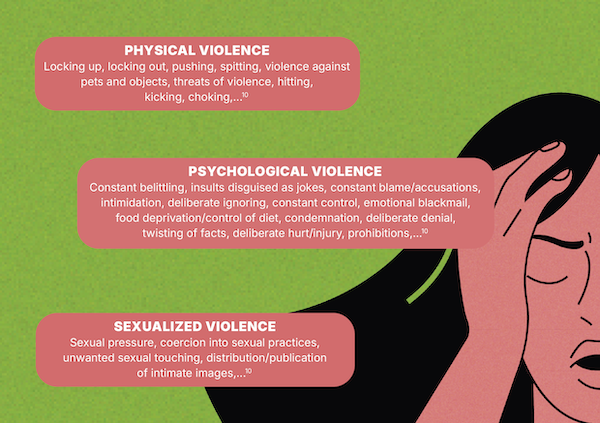
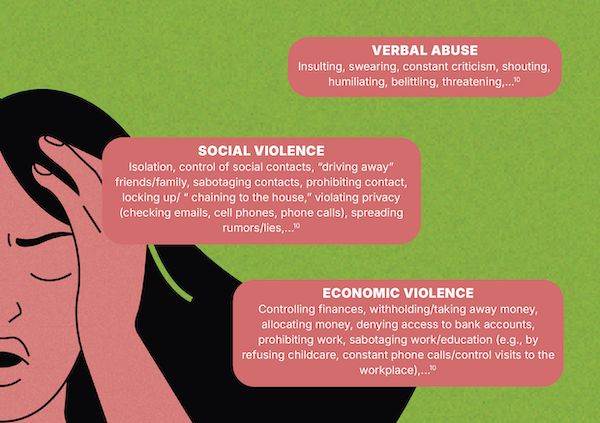
Just as there are thousands of ways to commit violence, there are also thousands of ways to portray violence. Intimate partner violence has many faces. Understanding this is the first step toward sensitively portraying violence in relationships. The main point is that violence within intimate relationships is portrayed in a multifaceted way. For a more sensitive portrayal of intimate partner violence, it is helpful to...
... to show a certain number of depictions of violence.
... to focus most strongly on psychological violence.
Side effect: The integration of different forms of violence into storytelling leads to very different visual impressions (for example, verbal violence is portrayed differently as social violence). This heightens the tension in the film and creates surprise effects.
Violence comes in cycles
Dramaturgy
The agony of choice is already present in the writing of the screenplay. This is because the film has an endless number of dramatic variations at its disposal. Thus, the staging of an abusive relationship can take on very different forms.
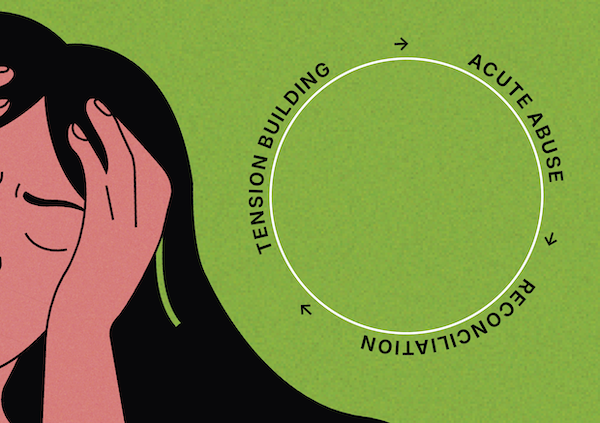
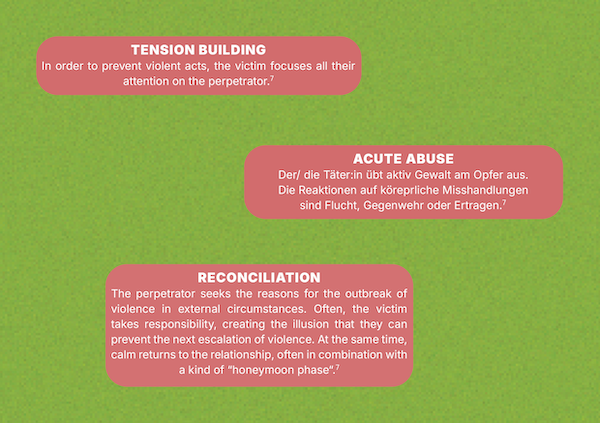
However, there is one element that it should definitely include: the spiral of violence. During periods of calm, violent relationships can also be loving. This is what makes it so difficult to leave them. Reality is often trivialized by a “veil of love,” and violence is "forgiven" or "forgotten.” In order to portray relationship violence sensitively and realistically, it is therefore essential...
... to fully depict the spiral of violence.
Side effect: The integration of the spiral of violence into the narrative automatically brings with it a conflict (Should I stay or should I go?) – and that is something a film usually needs, because conflict is the driving force in most film plots.
Violence changes those affected
Character
No matter how clever the dramaturgy of a film is, it is the characters that are crucial to its success—they are the ones who breathe life into the stories.
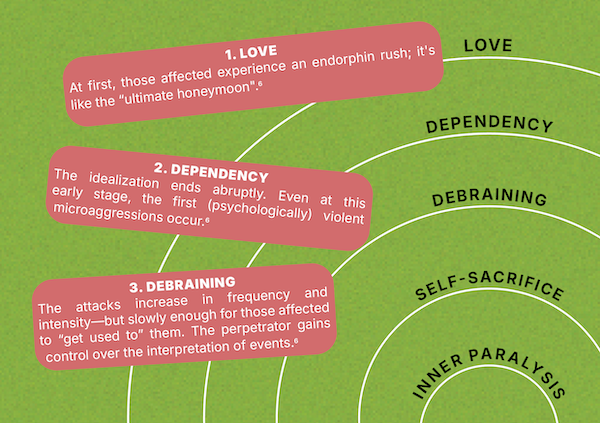
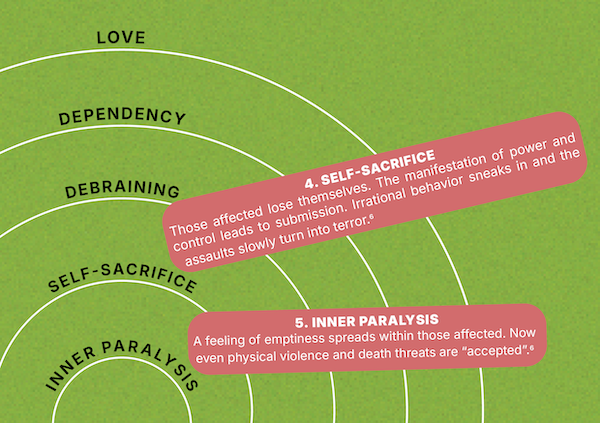
No one, including movie characters, would consciously enter into an abusive relationship. The tricky thing is that the first phase resembles a completely normal start to a relationship—two people fall in love. And when the violence begins, the perpetrator is the most intimate person in the victim's life. A physical attack is preceded by many stages. The victim is then so emotionally entangled with the perpetrator that they may no longer even perceive the physical violence as such. Relationship violence is an entanglement of dependencies, hatred, and love. For a sensitive portrayal of domestic violence, it is helpful...
... to show physical violence coupled with the level of “inner rigidity.”
Side effect: By incorporating the psychological downward spiral, the external conflict of the story becomes the internal conflict of the film character. This creates depth. The more stages of the psychological downward spiral she goes through, the more the audience can identify with her.
Violence is a part of social norms
Self-check
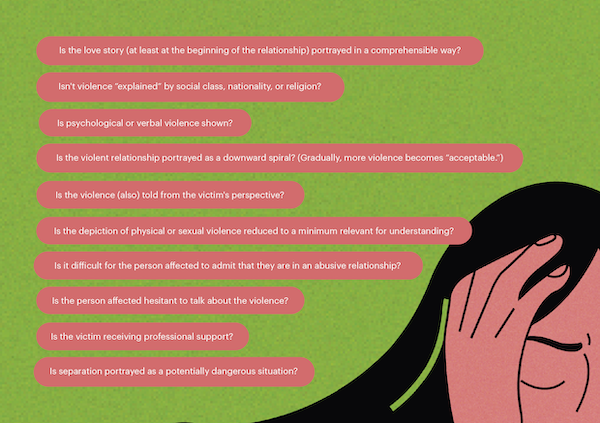
Congratulations! You have already created a screenplay or a film. Then your work is ready for self-assessment. Regardless of the core theme and genre, these questions can provide important insights into assessing the sensitivity of a film or lead to improvements in the screenplay.
Side effect: The sensitive portrayal of domestic violence could lead to greater awareness in society and thus to a more sensitive approach to those affected, or even to the prevention of violence.
Intimate partner violence is a complex, multidimensional phenomenon that goes beyond physical assault and leaves deep, often invisible scars on those affected, particularly in the area of psychological violence. A realistic cinematic portrayal must therefore make psychological violence visible, embed it in the context of structural power relations, and comprehensibly portray the subjective perception of those affected.
The following questionnaire provides a list of criteria that can be used as a tool for analyzing sensitivity in film portrayals. It helps to identify problematic narratives and offers filmmakers guidance on how to deal with the topic of domestic violence in a more responsible manner when writing scripts or preparing for filming.
Each question can be answered with yes or no .
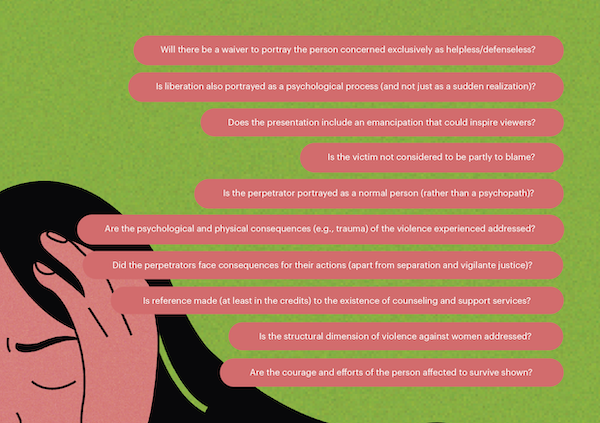
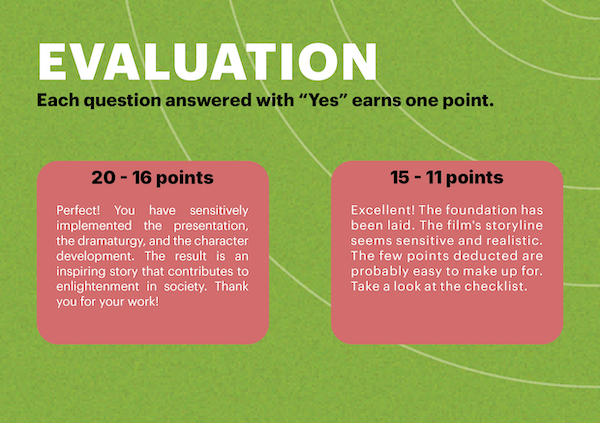
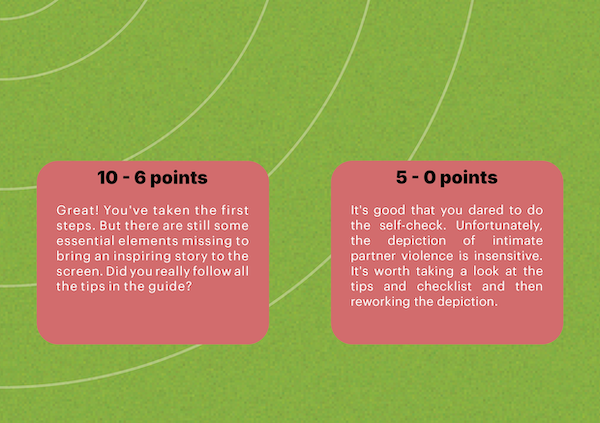
Show different forms of violence and focus on psychological violence! Show physical and sexual violence only as much as necessary! Display the spiral of violence in its full extent! Be aware of the mental downward spiral! Avoid inventing reasons for the violence in the perpetrator's environment or mental state! Show the victim as capable of defending themselves and courageous! Portray the victim's perspective! Also consider the representation of the structural dimension of violence! Refer to professional help! Consider the consequences of ongoing violence (during and after the relationship)!
A huge thank you to all supporters!
For dramaturgical expertise: Lisa Hasenhütl, Thomas Rossipaul, Valerie Keller, Tatjana Berlakovich, Ajda Sticker, Dominik Posch
For professional expertise: Andrea Lienhart, Isabella Emhofer, Theresa Gschwendner
For dramaturgical expertise: Susanne Siebel, Sabine Varetza-Pekarz
For constant dialogwhich has created the basis for the content (and brought the spelling and grammar to a pleasant level): Theresa Gschwendner, Hanna Vogel und Marie Farag!
And a special thanks for the love and patiencewithout this project would not be possible goes to Floriano Schneiter Ruf!
More Posts

 English
  German